
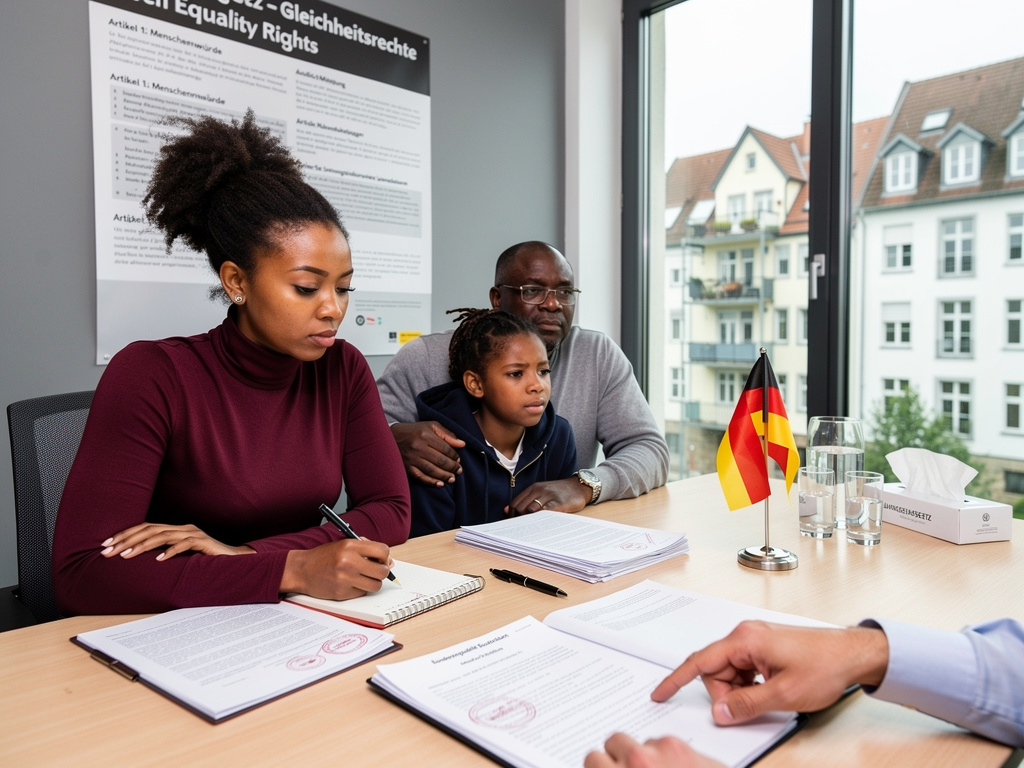
Racism and Discrimination in Germany: Your Rights and Where to Get Help
⚡ TL;DR
Discrimination on grounds of ethnic origin and race is illegal in Germany under the General Equal Treatment Act (AGG). The law protects you at work, in housing, at restaurants and clubs, and in most everyday transactions. If you experience discrimination, you have 2 months to make a formal complaint under the AGG. The Antidiskriminierungsstelle des Bundes (federal anti-discrimination agency) offers free, confidential counselling at antidiskriminierungsstelle.de. The ISD (Initiative Schwarze Menschen in Deutschland) provides community solidarity and political advocacy. Racial profiling by police violates Article 3 of the German Basic Law.
Racism in Germany: Naming It and Knowing Your Rights
Racism in Germany is real, documented, and experienced by the African community and Black people in Germany daily. It ranges from subtle everyday microaggressions — being asked "where are you really from?" or being surveilled more closely in shops — to structural discrimination in hiring and housing, and in some cases physical violence and targeted hate crimes.
Acknowledging this reality is not a sign of weakness or a reason to leave. Germany has legal protections against discrimination, active organisations fighting for equality, and growing awareness — including among Germans — of structural racism. Understanding your rights is one of the most practical things you can do.
The Legal Framework: The AGG
The Allgemeines Gleichbehandlungsgesetz (AGG) — the General Equal Treatment Act — has been in force since 2006 [1][3]. It prohibits discrimination on the grounds of:
-
Ethnic origin and race
-
Gender
-
Religion or belief
-
Disability
-
Age
-
Sexual orientation
Where the AGG applies:
-
Work and employment — job advertisements, hiring, working conditions, promotion, dismissal
-
Everyday commercial transactions (Massengeschäfte) — shops, restaurants, banks, insurance companies, clubs, discotheques, gyms — any business that offers goods or services to the general public
-
Housing market — landlords cannot refuse to rent based on ethnic origin or race
Where the AGG does NOT fully apply:
-
Government actions and public authorities — police conduct, immigration authorities, courts. The AGG does not regulate the state-citizen relationship in the same way [1][2]. However, Article 3 of the German Basic Law (Grundgesetz) prohibits discrimination by the state, including government agencies.
What discrimination is covered
The AGG covers both direct discrimination (treating you worse because of your ethnic origin) and indirect discrimination (a rule or practice that appears neutral but disproportionately disadvantages people of a certain ethnic background) [3][4].
Where Discrimination Happens Most: Documented Patterns
The Antidiskriminierungsstelle des Bundes (Federal Anti-Discrimination Agency) consistently reports that ethnic and racial discrimination is highest in:
-
The housing market — landlords or agents refusing to show or rent to Black and Brown applicants [1][2]
-
Employment — not being invited to interviews, being passed over for promotion, hostile workplace comments
-
Clubs, bars, and venues — being refused entry or given discriminatory dress codes [4]
-
Banks and financial institutions — requiring more documentation from Black applicants
-
Education — being assigned to lower school tracks based on origin rather than ability
-
Public spaces and police contact — being subjected to more frequent checks [2]
Your Rights in Specific Situations
Refused entry to a club or bar
If you are refused entry to a venue and there is reason to believe it was based on your ethnic origin (e.g. your lighter-skinned companions were allowed in, the stated reason was vague), this is potentially illegal under the AGG [4]. A Syrian student who was refused entry to a discotheque while his German friends entered freely successfully sued and was awarded €1,000 in compensation [4].
What to do: Note the date, time, location, who refused you, and any witnesses. Ask the door staff for the reason in writing (they don't have to provide one, but asking is worth it). Make a complaint within 2 months.
Discriminated against at work
Your employer must ensure your workplace is free from discrimination and harassment. If you experience racist comments, being treated worse than comparable colleagues, or being passed over for opportunities, you can:
-
File an internal complaint with your employer (they are legally obliged to investigate)
-
File a complaint with the works council (Betriebsrat) if one exists
Refused housing based on race or origin
Landlords cannot refuse to rent based on ethnic origin [1]. If you believe this happened, document everything — the advertisement, your application, the refusal. A rental refused to someone of African origin while the same landlord accepted German applicants with similar profiles is potentially an AGG violation.
Police stops and racial profiling
Racially motivated identity checks (Racial Profiling) by police violate Article 3 Paragraph 3 of the German Basic Law [2]. Courts have ruled specifically on this — a 2016 ruling by the Higher Administrative Court of Rhineland-Palatinate found that an identity check of a Black German family on a train was unlawful because skin colour was used as a criterion [2].
If stopped by police: You have the right to ask why you are being stopped. You do not have to answer questions beyond identifying yourself (name, address, date of birth). You can note the officer's badge number and department. Berlin residents have additional protections under the Berlin Anti-Discrimination Act (LADG, 2020) which extends AGG-like protections to public authority conduct in Berlin [2].
How to File a Complaint
Time limit: 2 months
Under the AGG, you have 2 months from the date of the discriminatory act to make a formal complaint [1][3][4]. Missing this deadline may end your legal options, so act promptly.
Step 1: Document everything
-
Write down exactly what happened — date, time, location, what was said or done, witnesses
-
Keep any written evidence (messages, emails, rejection letters, screenshots)
-
Note the full name and details of the person or organisation involved
Step 2: Contact the Antidiskriminierungsstelle des Bundes
antidiskriminierungsstelle.de — The Federal Anti-Discrimination Agency offers free, confidential counselling by phone and email [1][2]. They can advise you on whether what happened constitutes a violation of the AGG, what your options are, and help you find a local counselling centre near you.
📞 Phone counselling available 🌐 Online contact form at antidiskriminierungsstelle.de
Step 3: Seek legal advice
For serious cases — particularly work discrimination or housing — consult a lawyer (Rechtsanwalt) specialising in Arbeitsrecht (employment law) or Antidiskriminierungsrecht. Many anti-discrimination organisations offer free initial legal consultations.
Fair Integration — counselling project for migrants experiencing discrimination, available in multiple languages.
ISD and local Black community organisations — can provide peer support, solidarity, and referrals to legal services.
Step 4: File a formal complaint
Complaints under the AGG can be filed:
-
With your employer's complaints process (in employment situations)
-
Directly with a court (Amtsgericht or Arbeitsgericht for employment)
-
Through the Antidiskriminierungsstelle as a mediator
Hate Crimes and Physical Violence
If you experience or witness a racially motivated attack, threatening behaviour, or hate speech directed at you personally:
Call 110 (police emergency) or 112 (general emergency). In Germany, racially motivated offences are treated as aggravating factors under the German Criminal Code (§ 46 StGB), which courts must consider in sentencing.
File a criminal complaint (Strafanzeige) at your local police station. If you believe the police themselves are responding inadequately, contact:
-
VBRG (Verband der Beratungsstellen für Betroffene rechtsextremer und rassistischer Gewalt) — a national network of counselling centres for victims of right-wing extremist and racist violence
-
Reach Out Berlin — victim counselling, education against right-wing extremism, racism, and antisemitism
Frequently Asked Questions
Research and documented reports consistently confirm that Black people in Germany, including those of African origin, experience higher rates of discrimination in employment, housing, police contact, and everyday life than the white German majority [1][2]. This includes microaggressions that can be difficult to document but accumulate into real psychological and material harm. Knowing your rights and having community around you matters enormously.
References
-
Antidiskriminierungsstelle – Ethnic Origin / Racism – antidiskriminierungsstelle.de
-
Antidiskriminierungsstelle – Frequently Asked Questions about Racial Profiling
-
Antidiskriminierungsstelle – General Equal Treatment Act (AGG)
-
Protection against Discrimination in Germany – antidiskriminierungsstelle.de
Get New Articles Delivered
Be the first to read our latest guides and resources as soon as they're published.